
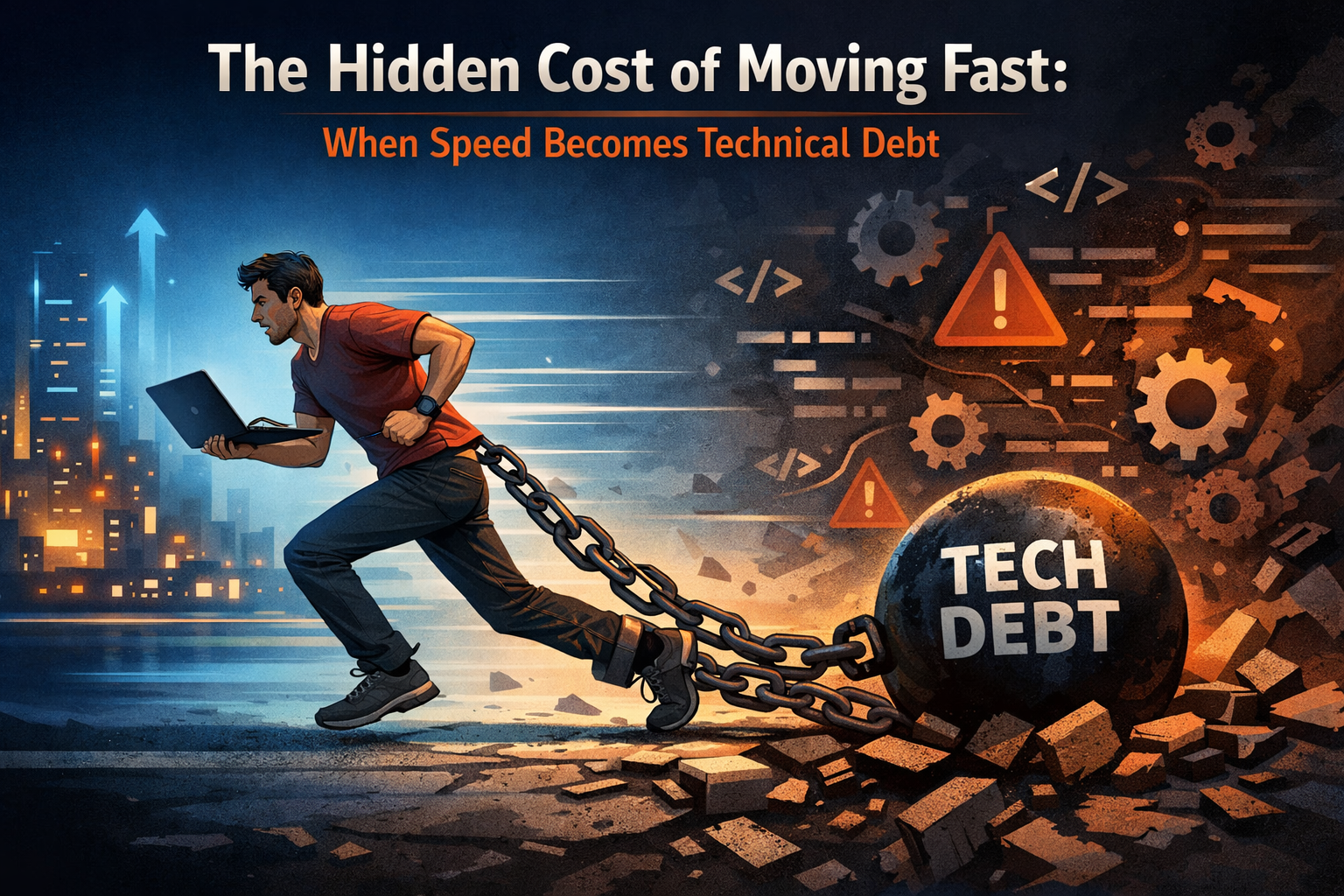
Introduction: Speed Feels Like a Superpower
In the early stages of building a product, speed feels like a superpower.
Ideas move quickly. Features are shipped in record time. Teams celebrate momentum, and users begin to take notice. In a competitive environment, moving fast is often seen as the difference between success and irrelevance.
However, beneath that speed, something quieter begins to accumulate: technical debt.
At first, it’s barely noticeable just a few shortcuts taken to meet deadlines, a quick fix instead of a long-term solution, or a piece of code that “works for now.” These decisions are often justified in the name of progress.
And in the beginning, they make sense.
When Speed Stops Being an Advantage
Over time, those same shortcuts begin to slow things down.
What once took hours starts taking days. Simple updates become risky, and new features break existing ones. As a result, developers spend more time fixing issues than building new value.
This is when speed quietly turns into friction.
In reality, technical debt is not just about messy code, it’s about reduced agility. It limits how quickly a team can respond to change, adapt to new opportunities, or scale effectively.
Ironically, the pursuit of speed can eventually make a team slower.
How Technical Debt Builds Up
Technical debt doesn’t appear overnight. Instead, it accumulates through everyday decisions, such as:
- Skipping proper testing to meet deadlines
- Hardcoding logic instead of building flexible systems
- Ignoring documentation
- Delaying refactoring indefinitely
- Building features without considering long-term impact
Individually, these decisions may seem harmless. However, over time, they create systems that are fragile, difficult to maintain, and resistant to growth.
Consequently, the longer they remain unaddressed, the more expensive they become to fix.
The Real Cost: Beyond Code
Many teams assume technical debt is purely an engineering problem.
However, it affects the entire business.
- Product delays: New features take longer to release
- Poor user experience: Bugs and performance issues increase
- Team frustration: Developers burn out dealing with recurring problems
- Lost opportunities: Businesses struggle to adapt to market changes
Ultimately, technical debt doesn’t just slow systems—it slows progress.
Balancing Speed with Sustainability
The solution is not to stop moving fast. Instead, it’s to move intentionally.
High-performing teams understand that speed and quality are not opposites—they are partners. Therefore, they build systems that support both present and future growth.
This includes:
- Writing clear and maintainable code
- Investing in testing and automation
- Scheduling time for refactoring
- Making thoughtful architectural decisions early
- Treating technical debt as something to manage, not ignore
In other words, speed should not come at the expense of stability—it should be built on top of it.
A Smarter Way to Build
The most successful products are not necessarily the ones that moved the fastest at the beginning.
Instead, they are the ones that sustained their speed over time.
They evolve without breaking. They scale without chaos. They grow without constant rewrites.
And that only happens when teams recognize that every shortcut has a cost and choose carefully when to take it.
Final Thoughts
Moving fast will always be important.
However, moving fast without direction creates problems that eventually slow everything down.
Technical debt is not a failure, it’s a signal. A reminder that speed must be balanced with discipline, and progress must be built on solid foundations.
Because in the long run, the goal is not just to move fast.
It’s to keep moving forward without breaking along the way.
