Going digital doesn’t necessarily mean your business is automated.
Many businesses invest in technology to improve efficiency. But there’s an important difference between *digitalization* and *automation* that often gets overlooked.
Let’s break it down.
Digitalization: Moving Information into Digital Formats
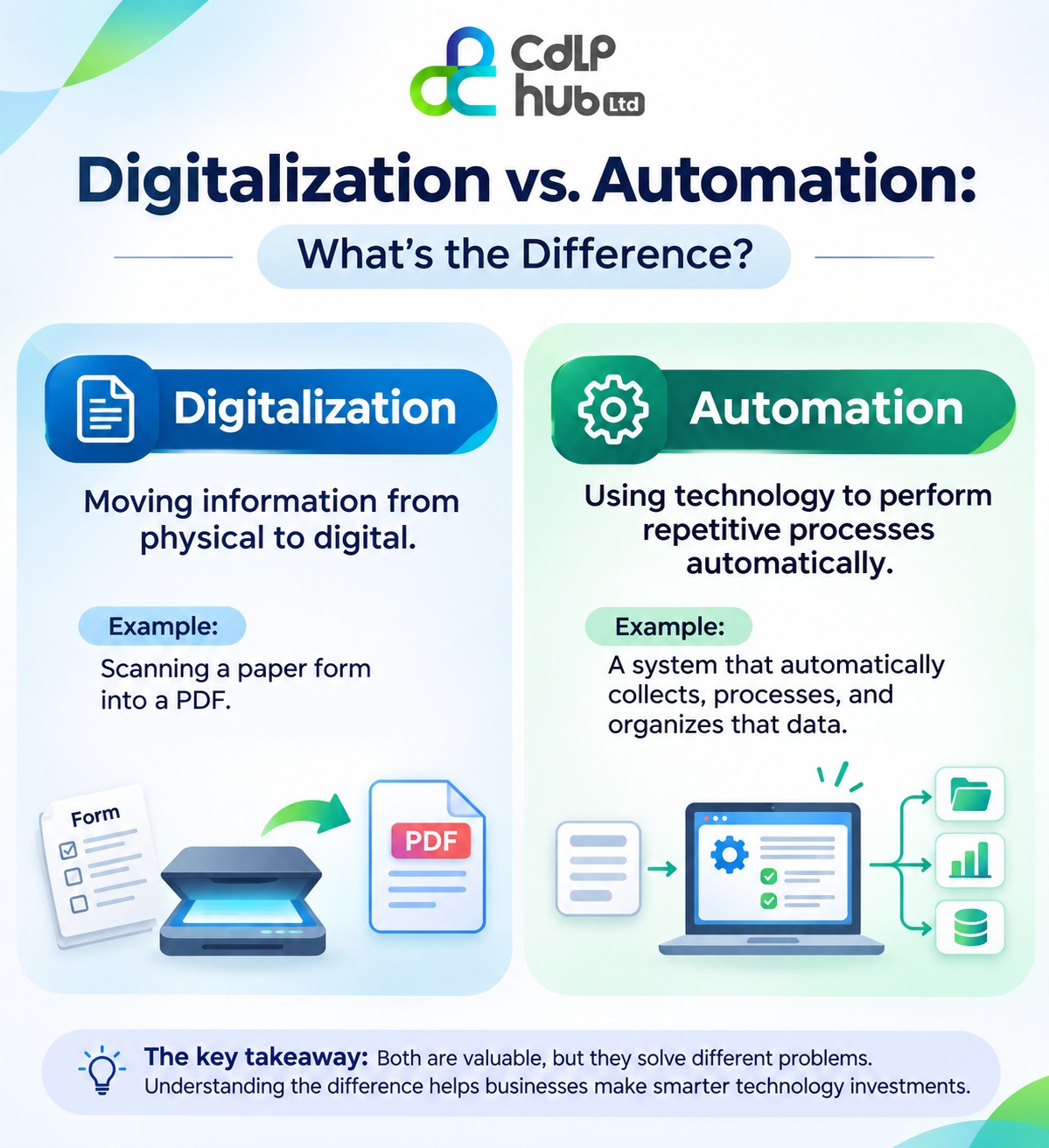
Imagine your business uses paper forms to collect customer information.
You decide to scan those forms and store them as digital documents instead.
That’s digitalization.
You’ve made the information easier to store, access, and share. But someone may still need to manually review, enter, and organize the data.
Automation: Making Processes Work with Minimal Manual Effort
Now, imagine replacing those paper forms with an online system that automatically collects customer details, processes the information, updates your records, and organizes everything in the right place.
That’s automation.
Instead of employees repeatedly handling the same tasks, the system takes care of them.
So, what’s the real difference?
Digitalization changes how information is stored and accessed.
Automation changes how work gets done.
Both are valuable, but they solve different problems.
Digitalization helps businesses move away from paper-based systems, while automation reduces repetitive tasks, saves time, and improves workflow efficiency.
The key takeaway:
Adopting technology isn’t just about replacing paper with screens. It’s about understanding which processes need to become digital and which ones need to work more efficiently.
Because a process can be digital and still be completely manual.
A question worth asking: Is your business simply going digital, or is it actually reducing manual work?
